
From : Ref. Encyclopedia Britannica
Marine craft: ships, high-speed craft, semi-submersibles, floating rigs, submarines, remotely operated and autonomous underwater vehicles, torpedoes and other propelled/powered structures for instance a floating air field.
Vehicles that do not travel on land (ocean and flight vehicles) are usually called craft.
Vessel: “hollow structure made to float upon the water for purposes of transportation and navigation; especially, one that is larger than a rowboat “. The words vessel, ship and boat are often used interchangeably. In Encyclopedia Britannica, a ship and a boat are distinguished by their size through the following definition:
Ship: “any large floating vessel capable of crossing open waters, as opposed to a boat, which is generally a smaller craft. The term formerly was applied to sailing vessels having three or more masts; in modern times it usually denotes a vessel of more than 500 tons of displacement.
Submarine: “any naval vessel that is capable of propelling itself beneath the water as well as on the water’s surface.
Underwater Vehicle: “small vehicle that is capable of propelling itself beneath the water
surface as well as on the water’s surface. This includes unmanned underwater vehicles (UUV), remotely operated vehicles (ROV) and autonomous underwater vehicles (AUV).
Maneuvering:
Assumes that the ship is moving in restricted calm water. Hence, the
maneuvering model is derived for a ship moving at positive speed U under a
zero-frequency wave excitation assumption such that added mass and
damping can be represented by using hydrodynamic derivatives (constant
parameters).
The zero-frequency assumption is only valid for surge, sway and yaw since the
natural period of a PD controlled ship will be in the range of 100-150 s. For
150 s this result in:
ω n = 2π / T ≈ 0.04 rad/s

dari slides NTNU di atas, kita dapat perhati yang Xu Xu_dot,, Xv Xv_dot dan seterusnya adalah “kecerunan” seperti di dalam basic linear equation y=mx+c
Jadi, Xu, Xu_dot,, Xv , Xv_dot adalah “m” untuk setiap terma. Jadi, Xu bermakna (force X yang dibahagi terhadap u), dan di dapati dari different cases, lalu didapatkan “kecerunan m” overall cases tersebut. contohnya, kecerunan untuk Xu1, Xu2, Xu3 lalu di regressed LSM, di dapatkan satu Xu untuk semua cases. Begitu juga dengan lain-lain.
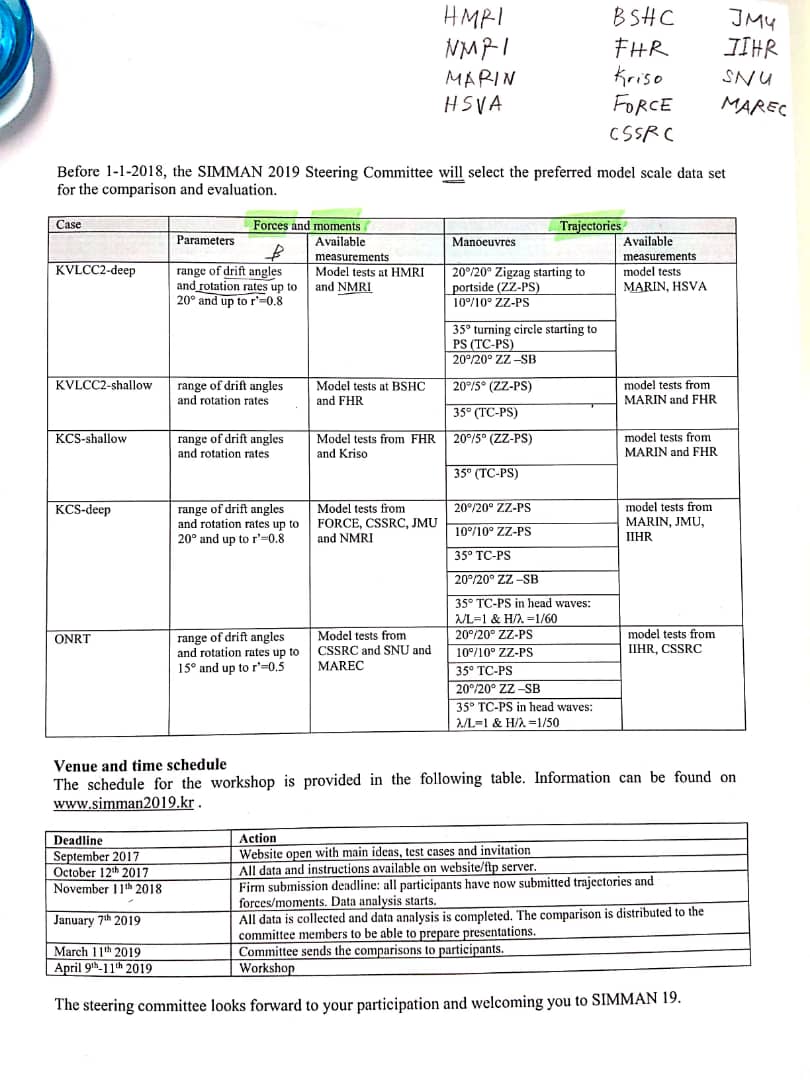
Jadi untuk case MMG, coefficient-coefficient (Xu, Xv, Nu, Nv etc) ini didapati dari experiments CMT dan OTT.
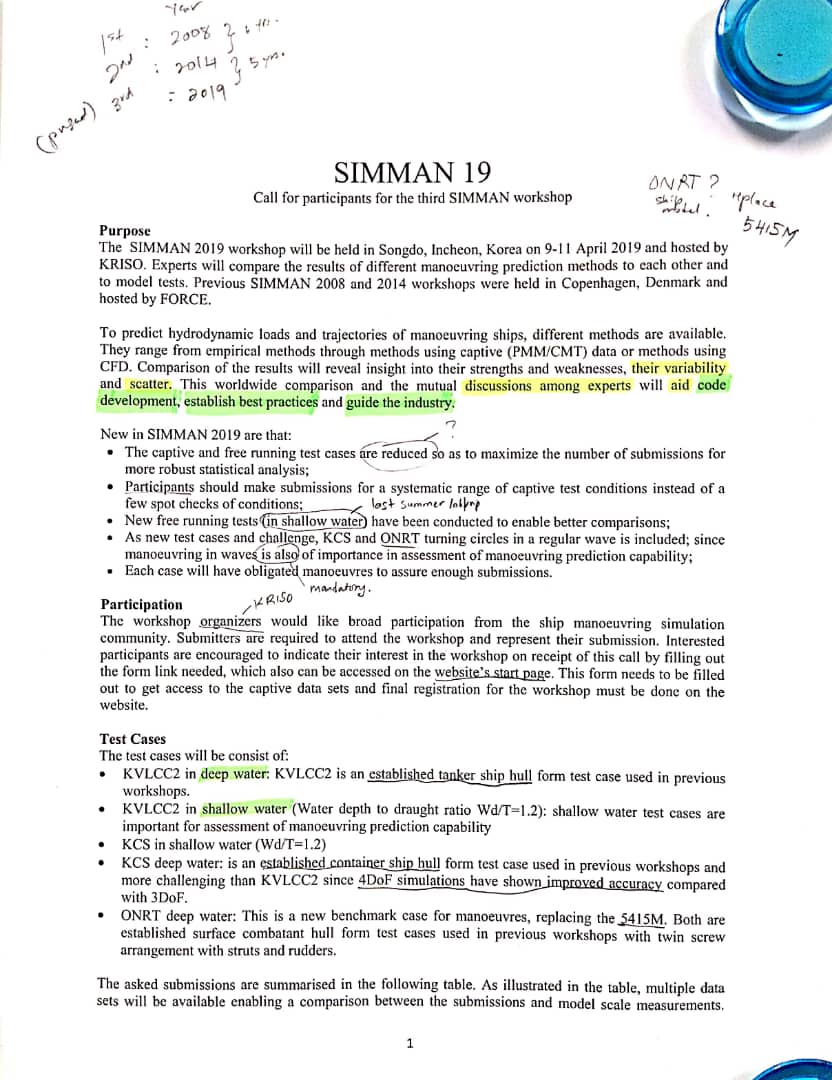
untuk dikaitkan dengan research yang ada sekarang, sensei ada menyebut yang apabila kes KVLCC2 yang lebih “teruk” drift dalam turning dalam wave berbanding KCS. Sensei menyebut yang KCS memiliki high damping compared to KVLCC2 so that is why KCS better in term of turning trajectory eventhough the same wave effect was exerted on the ship.
For the same approach speed, KVLCC2 drifts more significantly than KCS. This may be because the damping force acting on the KCS with respect to the lateral motion is larger than that on the KVLCC2.
1st paper 2019.mar.19(draft before submit)
jadi dari quote dari paper 1st di atas, dapat kita simpulkan dari slide NTNU…yang mana Xv, Yv dan maybe also Nv adalah tinggi (or rendah? note: semakin tinggi nilai coefficient kecerunan, semakin tinggi effect force (sensitif) tersebut di dalam arah tersebut) di KCS ( cuba check dari data experiment) berbanding KVLCC2. Semakin rendah kecerunan, maknanya kurang sensitif force itu dalam arah itu. Jadi…untuk kes KCS ini, kemungkinan KCS kurang sensitif dengan lateral motion jadi menyebabkan hull body nya itu tidak “hanyut” banyak walaupun di kena kan daya gelombang yang sama magnitud dengan KVLCC2. KVLCC2 pula di mana hanyut lebih banyak kerana damping force acting pada body kapal adalah rendah. Secara fizik law nya, ini terjadi kerana Cb ( Block Coeff.) KVLCC2 adalah lebih besar, menyebabkan kadar menyerap tindakan daya air(gelombang) adalah rendah kerana terpaksa “menyerap” disebabkan memiliki permukaan yang terdedah yang lebih besar berbanding KCS. KCS, yang mana lebih “nipis” dan kurang permukaan yang terdedah itu, boleh hanya menggunakan daya yang kecil untuk ” mengharungi” daya gelombang yang sama. Jadi, ia menyebabkan KCS hanyut lebih rendah berbanding KVLCC2. Dan ini menerangkan quote sensei di atas.
“because the damping force acting on the KCS with respect to the lateral motion is larger than that on the KVLCC2 “


 Kemudi Kehidupan